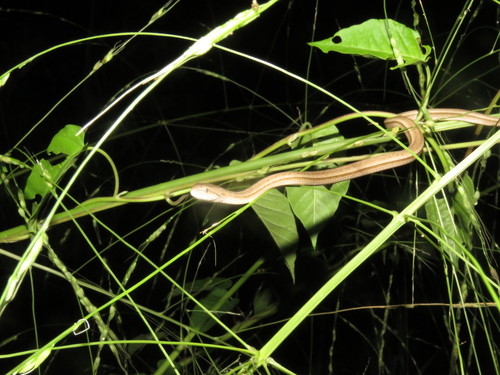
Amazon Coastal House Snake
Thamnodynastes pallidus
- Venom
- Not venomous
- To people
- Harmless
- Constrictor
- Not documented
- Type
- Colubrid
- Family
- Colubridae
- Genus
- Thamnodynastes
- Continents
- South America
- Countries
- 9
- How common
- Recorded in 62 places on iNaturalist
About
Amazon Coastal House Snake (Thamnodynastes pallidus) is a non-venomous colubrid of the family Colubridae, found in Bolivia, Brazil, Colombia, Ecuador, French Guiana and 4 more. It lives in habitats such as tropical rainforest, tropical moist forest, tropical lowland forest, tropical montane forest and 46 more. Recorded in 62 places on iNaturalist.
Where it lives
States, provinces and islands
- Bolivia: Beni 47 species, Santa Cruz 54 species
- Brazil: Amapá 39 species, Amazonas 85 species, Bahia 126 species, Paraíba 46 species, Pernambuco 42 species, Rio Grande do Sul 91 species, Sergipe 40 species
- Colombia: Amazonas 51 species, Atlántico 15 species, Bolívar 22 species, Córdoba 17 species, Cundinamarca 36 species, Guaviare 17 species, La Guajira 20 species, Meta 44 species, Sucre 13 species, Vichada 17 species
- Peru: Loreto 59 species
- Suriname: Commewijne 10 species, Nickerie 7 species, Wanica 5 species
Cities in its range
Big cities inside the states and provinces where it is recorded - not individual sightings.
- Aracaju Brazil
- Barranquilla Colombia
- Campina Grande Brazil
- Canoas Brazil
- Cartagena Colombia
- Caruaru Brazil
- Caxias do Sul Brazil
- Feira de Santana Brazil
- Gravataí Brazil
- Itabuna Brazil
- Jaboatão Brazil
- Jaboatão dos Guararapes Brazil
- João Pessoa Brazil
- Macapá Brazil
- Manaus Brazil
- Montería Colombia
- Novo Hamburgo Brazil
- Olinda Brazil
- Paulista Brazil
- Pelotas Brazil
- Porto Alegre Brazil
- Recife Brazil
- Salvador Brazil
- Santa Maria Brazil
- Sincelejo Colombia
- Soacha Colombia
- Soledad Colombia
- São Leopoldo Brazil
- Viamão Brazil
- Villavicencio Colombia
- Vitória da Conquista Brazil
Habitats
Estimated from where this snake is recorded and what kind of snake it is - not a confirmed habitat survey.
- Tropical Rainforest
- Tropical Moist Forest
- Tropical Lowland Forest
- Tropical Montane Forest
- Montane Rainforest
- Cloud Forest
- Tropical Dry Forest
- Subtropical Forest
- Subtropical Dry Forest
- Evergreen Forest
- Broadleaf Forest
- Coastal Forest
- Gallery Forest
- Woodland
- Dry Woodland
- Scrub Forest
- Thorn Forest
- Mountain Forest
- Secondary Forest
- Regenerating Forest
- Forest Edges
- Forest Clearings
- Savanna
- Tropical Savanna
- Wet Savanna
- Grassland
- Tropical Grassland
- Temperate Grassland
- Shrubland
- Scrubland
- Semi-Desert
- Mountain Slopes
- Highlands
- Valleys
- Waterholes
- Coastal Scrub
- Roadsides
- Amazon Rainforest
- Amazon Lowland Rainforest
- Amazon Terra Firme Forest
- Atlantic Rainforest
- Guiana Shield Rainforest
- Andean Cloud Forest
- Andean Yungas
- Pantanal Wetlands
- Caatinga Dry Forest
- Gran Chaco Woodland
- Llanos Grassland
- Pampas Grassland
- Coastal Restinga
Related snakes
- Thamnodynastes phoenix
- Thamnodynastes silvai
- Thamnodynastes gambotensis
- Thamnodynastes sertanejo
- Coastal House Snake (strigatus) Thamnodynastes strigatus
- Thamnodynastes chaquensis
- Thamnodynastes longicauda
- Thamnodynastes marahuaquensis
- Roze's Coastal House Snake Thamnodynastes chimanta
- Thamnodynastes yavi
- Thamnodynastes duida
- Thamnodynastes hypoconia
- Prado's Coastal House Snake Thamnodynastes rutilus
- Thamnodynastes ramonriveroi
- Thamnodynastes almae
- Thamnodynastes corocoroensis
- Thamnodynastes lanei
- Thamnodynastes ceibae
- Thamnodynastes paraguanae
- Thamnodynastes dixoni
- Thamnodynastes nattereri
Stay safe: a photo or a web page can never tell you for certain that a snake is harmless. Keep your distance, never handle a wild snake, and get medical help straight away after any bite.