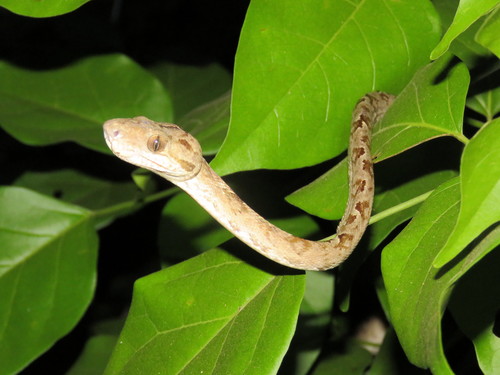
Amazon Tree Boa
Corallus hortulana
- Venom
- Not venomous
- To people
- Harmless
- Constrictor
- Constrictor
- Type
- Boa
- Family
- Boidae
- Genus
- Corallus
- Continents
- South America
- Countries
- 10
- How common
- Common
About
Amazon Tree Boa (Corallus hortulana) is a non-venomous boa of the family Boidae, found in Bolivia, Brazil, Colombia, Ecuador, French Guiana and 5 more. It lives in habitats such as tropical rainforest, tropical moist forest, tropical lowland forest, tropical montane forest and 45 more. Common: recorded in 582 places on iNaturalist.
Where it lives
States, provinces and islands
- Bolivia: Beni 47 species, La Paz 33 species, Pando 14 species, Santa Cruz 54 species
- Brazil: Acre 38 species, Amazonas 85 species, Bahia 126 species, Ceará 58 species, Distrito Federal 20 species, Espírito Santo 59 species, Minas Gerais 103 species, Pará 121 species, Pernambuco 42 species, Piauí 54 species, Rio de Janeiro 82 species, Roraima 69 species, Sergipe 40 species
- Ecuador: Morona-Santiago 48 species, Orellana 44 species, Pastaza 48 species, Sucumbíos 37 species, Tungurahua 54 species
- Guyana: Mahaica-Berbice 1 species, Potaro-Siparuni 15 species, Upper Demerara-Berbice 20 species
- Peru: Huanuco 10 species, Loreto 59 species, Madre de Dios 56 species, Puno 2 species, San Martín 35 species
- Suriname: Brokopondo 18 species, Commewijne 10 species, Nickerie 7 species, Para 19 species, Saramacca 1 species, Sipaliwini 25 species
Cities in its range
Big cities inside the states and provinces where it is recorded - not individual sightings.
- Ananindeua Brazil
- Aracaju Brazil
- Belford Roxo Brazil
- Belo Horizonte Brazil
- Belém Brazil
- Betim Brazil
- Boa Vista Brazil
- Brasília Brazil
- Campos dos Goytacazes Brazil
- Caruaru Brazil
- Caucaia Brazil
- Contagem Brazil
- Duque de Caxias Brazil
- Feira de Santana Brazil
- Fortaleza Brazil
- Governador Valadares Brazil
- Ipatinga Brazil
- Itabuna Brazil
- Jaboatão Brazil
- Jaboatão dos Guararapes Brazil
- Juazeiro do Norte Brazil
- Juiz de Fora Brazil
- Manaus Brazil
- Montes Claros Brazil
- Niterói Brazil
- Nova Iguaçu Brazil
- Olinda Brazil
- Paulista Brazil
- Petrópolis Brazil
- Recife Brazil
- Ribeirão das Neves Brazil
- Rio Branco Brazil
- Rio de Janeiro Brazil
- Salvador Brazil
- Santa Luzia Brazil
- Serra Brazil
- Sete Lagoas Brazil
- São João de Meriti Brazil
- Teresina Brazil
- Uberaba Brazil
- Uberlândia Brazil
- Vila Velha Brazil
- Vitória Brazil
- Vitória da Conquista Brazil
- Volta Redonda Brazil
Habitats
Estimated from where this snake is recorded and what kind of snake it is - not a confirmed habitat survey.
- Tropical Rainforest
- Tropical Moist Forest
- Tropical Lowland Forest
- Tropical Montane Forest
- Montane Rainforest
- Cloud Forest
- Tropical Dry Forest
- Tropical Seasonal Forest
- Subtropical Dry Forest
- Evergreen Forest
- Coastal Forest
- Gallery Forest
- Woodland
- Dry Woodland
- Open Woodland
- Scrub Forest
- Thorn Forest
- Mountain Forest
- Secondary Forest
- Regenerating Forest
- Forest Edges
- Forest Clearings
- Savanna
- Tropical Savanna
- Wet Savanna
- Grassland
- Tropical Grassland
- Shrubland
- Scrubland
- Semi-Desert
- Mountain Slopes
- Highlands
- Valleys
- Waterholes
- Coastal Scrub
- Roadsides
- Amazon Rainforest
- Amazon Lowland Rainforest
- Amazon Terra Firme Forest
- Atlantic Rainforest
- Guiana Shield Rainforest
- Andean Cloud Forest
- Andean Yungas
- Cerrado Savanna
- Pantanal Wetlands
- Caatinga Dry Forest
- Gran Chaco Woodland
- Coastal Restinga
- Caribbean Moist Forest
Related snakes
- Cropani's Boa Corallus cropanii
- Dormilona Corallus ruschenbergerii
- Cook's Tree Boa Corallus cookii
- Ringed Tree Boa Corallus annulatus
- Grenada Tree Boa Corallus grenadensis
- Emerald Tree Boa Corallus caninus
- Corallus priscus
- Blomber’s Tree Boa Corallus blombergi
- Bates' Tree Boa Corallus batesii
Stay safe: a photo or a web page can never tell you for certain that a snake is harmless. Keep your distance, never handle a wild snake, and get medical help straight away after any bite.