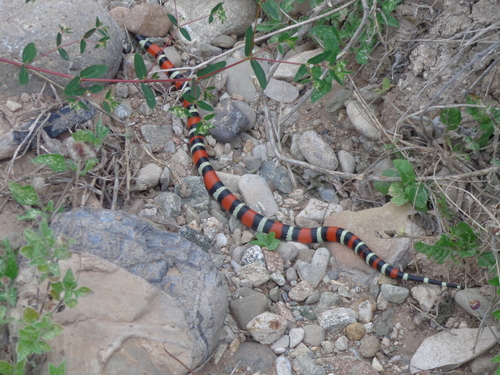
Atlantic Central American Milksnake
Lampropeltis polyzona
- Venom
- Not venomous
- Constrictor
- Constrictor
- Type
- Colubrid
- Family
- Colubridae
- Genus
- Lampropeltis
- Continents
- North America
- Countries
- 5
- How common
- Common
- Diet
- Eats other snakes
About
Atlantic Central American Milksnake (Lampropeltis polyzona) is a non-venomous colubrid of the family Colubridae, found in Guatemala, Honduras, Mexico, Nicaragua, United States. It is known to eat other snakes. It lives in habitats such as tropical rainforest, tropical moist forest, tropical lowland forest, tropical montane forest and 30 more. Common: recorded in 364 places on iNaturalist.
Where it lives
Native range
Habitats
Estimated from where this snake is recorded and what kind of snake it is - not a confirmed habitat survey.
- Tropical Rainforest
- Tropical Moist Forest
- Tropical Lowland Forest
- Tropical Montane Forest
- Montane Rainforest
- Cloud Forest
- Tropical Dry Forest
- Subtropical Dry Forest
- Evergreen Forest
- Pine Forest
- Scrub Forest
- Thorn Forest
- Montane Woodland
- Mountain Forest
- Secondary Forest
- Regenerating Forest
- Forest Edges
- Forest Clearings
- Scrubland
- Desert
- Hot Desert
- Coastal Desert
- Desert Scrub
- Mountain Slopes
Related snakes
- Greer’s Kingsnake Lampropeltis greeri
- South Florida Mole Kingsnake Lampropeltis occipitolineata
- California Mountain Kingsnake Lampropeltis zonata
- Madrean Mountain Kingsnake Lampropeltis knoblochi
- Prairie Kingsnake Lampropeltis calligaster
- Mole snake Lampropeltis rhombomaculata
- Webb's Kingsnake Lampropeltis webbi
- Mexican Kingsnake Lampropeltis mexicana
- Gray-banded Kingsnake Lampropeltis alterna
- Ruthvens Kingsnake Lampropeltis ruthveni
- Santa Catalina Kingsnake Lampropeltis catalinensis
- Desert Kingsnake Lampropeltis splendida
Stay safe: a photo or a web page can never tell you for certain that a snake is harmless. Keep your distance, never handle a wild snake, and get medical help straight away after any bite.