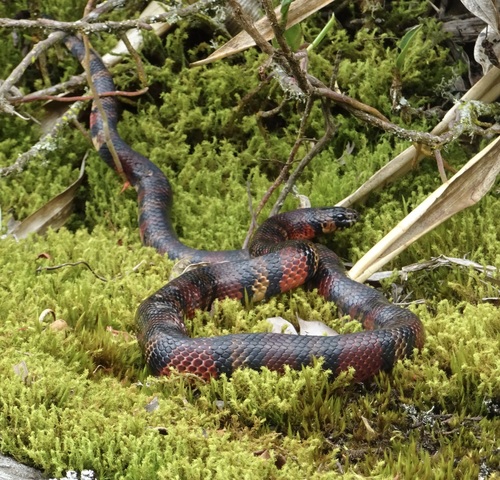
Black Milksnake
Lampropeltis micropholis
- Venom
- Not venomous
- To people
- Harmless
- Constrictor
- Constrictor
- Type
- Colubrid
- Family
- Colubridae
- Genus
- Lampropeltis
- Continents
- South America, North America
- Countries
- 6
- How common
- Common
- Diet
- Eats other snakes
About
Black Milksnake (Lampropeltis micropholis) is a non-venomous colubrid of the family Colubridae, found in Colombia, Costa Rica, Ecuador, Mexico, Panama and 1 more. It is known to eat other snakes. It lives in habitats such as tropical rainforest, tropical moist forest, tropical lowland forest, tropical montane forest and 22 more. Common: recorded in 216 places on iNaturalist.
Where it lives
States, provinces and islands
- Colombia: Huila 22 species, Valle del Cauca 57 species
- Costa Rica: Alajuela 80 species, Cartago 45 species, Guanacaste 72 species, Limón 62 species, Puntarenas 81 species, San José 63 species
- Ecuador: Esmeraldas 38 species, Guayas 16 species, Imbabura 18 species, Loja 19 species, Los Ríos 11 species, Manabí 26 species, Pichincha 41 species, Santo Domingo de los Tsáchilas 19 species
- Panama: Chiriquí 44 species, Coclé 34 species, comarca Ngäbe-Buglé 25 species, Panamá 61 species
- Venezuela: Tachira 15 species
Cities in its range
Big cities inside the states and provinces where it is recorded - not individual sightings.
- Buenaventura Colombia
- Cali Colombia
- Neiva Colombia
- Palmira Colombia
Habitats
Estimated from where this snake is recorded and what kind of snake it is - not a confirmed habitat survey.
- Tropical Rainforest
- Tropical Moist Forest
- Tropical Lowland Forest
- Tropical Montane Forest
- Montane Rainforest
- Cloud Forest
- Tropical Dry Forest
- Evergreen Forest
- Mountain Forest
- Secondary Forest
- Regenerating Forest
- Forest Edges
- Forest Clearings
- Mountain Slopes
- Highlands
- Valleys
- Fallen Logs
- Abandoned Buildings
- Roadsides
- Chocó Rainforest
- Andean Cloud Forest
- Mesoamerican Rainforest
- Central American Cloud Forest
- Central American Dry Forest
- Costa Rican Rainforest
- Panamanian Rainforest
Related snakes
- Greer’s Kingsnake Lampropeltis greeri
- South Florida Mole Kingsnake Lampropeltis occipitolineata
- California Mountain Kingsnake Lampropeltis zonata
- Madrean Mountain Kingsnake Lampropeltis knoblochi
- Prairie Kingsnake Lampropeltis calligaster
- Mole snake Lampropeltis rhombomaculata
- Webb's Kingsnake Lampropeltis webbi
- Mexican Kingsnake Lampropeltis mexicana
- Gray-banded Kingsnake Lampropeltis alterna
- Ruthvens Kingsnake Lampropeltis ruthveni
- Santa Catalina Kingsnake Lampropeltis catalinensis
- Desert Kingsnake Lampropeltis splendida
- Milk Snake Lampropeltis triangulum
- Mexican Milksnake Lampropeltis annulata
- Atlantic Central American Milksnake Lampropeltis polyzona
- Lampropeltis intermedius
- Black Kingsnake Lampropeltis nigra
- Scarlet Kingsnake Lampropeltis elapsoides
- Speckled Kingsnake Lampropeltis holbrooki
- California Kingsnake Lampropeltis californiae
- Mexican Kingsnake (leonis) Lampropeltis leonis
- Short-tailed Snake Lampropeltis extenuata
- Lampropeltis similis
- Sonoran Mountain Kingsnake Lampropeltis pyromelana
- Honduran milk snake Lampropeltis abnorma
- Central Plains Milksnake Lampropeltis gentilis
- Common Kingsnake Lampropeltis getula
Stay safe: a photo or a web page can never tell you for certain that a snake is harmless. Keep your distance, never handle a wild snake, and get medical help straight away after any bite.