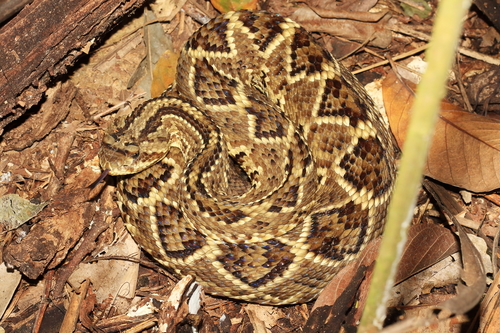
Cascabel Rattlesnake
Crotalus durissus
- Venom
- Venomous
- Constrictor
- Non-constrictor
- Type
- Pit Viper
- Family
- Viperidae
- Genus
- Crotalus
- Continents
- South America
- Countries
- 9
- How common
- Common
About
Cascabel Rattlesnake (Crotalus durissus) is a venomous pit viper of the family Viperidae, found in Argentina, Bolivia, Brazil, Colombia, French Guiana and 4 more. It lives in habitats such as tropical rainforest, tropical moist forest, tropical lowland forest, tropical montane forest and 60 more. Common: recorded in 647 places on iNaturalist.
Where it lives
Native range
Habitats
Estimated from where this snake is recorded and what kind of snake it is - not a confirmed habitat survey.
- Tropical Rainforest
- Tropical Moist Forest
- Tropical Lowland Forest
- Tropical Montane Forest
- Montane Rainforest
- Cloud Forest
- Tropical Dry Forest
- Tropical Seasonal Forest
- Subtropical Forest
- Subtropical Dry Forest
- Evergreen Forest
- Broadleaf Forest
- Coastal Forest
- Gallery Forest
- Woodland
- Dry Woodland
- Open Woodland
- Scrub Forest
- Thorn Forest
- Mountain Forest
- Secondary Forest
- Regenerating Forest
- Forest Edges
- Forest Clearings
Related snakes
- Crotalus caliginis
- San Esteban Island Rattlesnake Crotalus estebanensis
- Veracruz Neotropical rattlesnake Crotalus mictlantecuhtli
- Tehuantepec Isthmus Neotropical rattlesnake Crotalus ehecatl
- Crotalus muertensis
- Horsehead Island speckled rattlesnake Crotalus polisi
- Great Basin Rattlesnake Crotalus lutosus
- Crotalus aquaticus
- Isla Piojo Speckled Rattlesnake Crotalus thalassoporus
- Mexican Pygmy Rattlesnake Crotalus ravus
- Tiger Rattlesnake Crotalus tigris
- Western Diamond-backed Rattlesnake Crotalus atrox
Stay safe: a photo or a web page can never tell you for certain that a snake is harmless. Keep your distance, never handle a wild snake, and get medical help straight away after any bite.