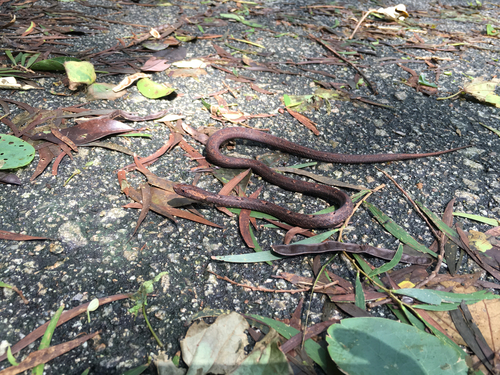
Common Mock Viper
Psammodynastes pulverulentus
- Venom
- Not venomous
- To people
- Harmless
- Constrictor
- Not documented
- Type
- Other
- Family
- Pseudaspididae
- Genus
- Psammodynastes
- Continents
- Asia
- Countries
- 11
- How common
- Common
About
Common Mock Viper (Psammodynastes pulverulentus) is a non-venomous snake of the family Pseudaspididae, found in Bangladesh, Cambodia, China, India, Indonesia and 6 more. It lives in habitats such as tropical rainforest, tropical moist forest, tropical lowland forest, tropical montane forest and 44 more. Common: recorded in 757 places on iNaturalist.
Where it lives
States, provinces and islands
- Bangladesh: Chattogram 23 species, Sylhet 29 species
- Cambodia: Koh Kong 25 species, Mondulkiri 9 species, Siem Reap 19 species
- China: Fujian 43 species, Guangdong 77 species, Guangxi 56 species, Guizhou 46 species, Hainan 42 species, Yunnan 78 species
- India: Andhra Pradesh 32 species, Arunachal Pradesh 63 species, Assam 64 species, Meghalaya 32 species, Mizoram 36 species, Sikkim 36 species, West Bengal 66 species
- Indonesia (islands): Bali 25 species, Bangka 24 species, Flores 13 species, Java 85 species, Kalimantan (Borneo) 113 species, Komodo 9 species, Lombok 9 species, Mentawai Islands 12 species, Natuna Islands 10 species, Riau Archipelago 11 species, Sulawesi 52 species, Sumatra 135 species, Sumba 7 species, Sumbawa 10 species
- Malaysia: Johor 40 species, Kedah 31 species, Pahang 49 species, Perak 34 species, Sabah 72 species, Sarawak 66 species, Selangor 55 species
- Myanmar: Tanintharyi 5 species
- Philippines: Bicol (Region V) 10 species, Cagayan Valley (Region II) 8 species, Central Visayas (Region VII) 21 species, Davao (Region XI) 14 species, Dinagat Islands (Region XIII) 8 species, Eastern Visayas (Region VIII) 12 species, MIMAROPA (Region IV-B) 24 species, Northern Mindanao (Region X) 7 species, SOCCSKSARGEN (Region XII) 3 species, Western Visayas (Region VI) 14 species, Zamboanga Peninsula (Region IX) 9 species
- Thailand: Chanthaburi 16 species, Chiang Mai 43 species, Chon Buri 18 species, Khon Kaen 11 species, Krabi 27 species, Lampang 9 species, Nakhon Nayok 20 species, Nakhon Ratchasima 34 species, Nan 19 species, Nong Khai 5 species, Phetchaburi 41 species, Phuket 22 species, Prachuap Khiri Khan 26 species, Ranong 15 species, Rayong 22 species, Sa Kaeo 11 species, Surat Thani 43 species, Trat 9 species
- Vietnam: Đắk Lắk 8 species, Bà Rịa-Vũng Tàu 7 species, Hòa Bình 12 species, Kiên Giang 8 species, Lâm Đồng 37 species, Ninh Bình 13 species, Đông Nam Bộ 34 species, Quảng Bình 8 species, Quảng Nam 22 species, Quảng Ninh 11 species, Thanh Hóa 17 species
Cities in its range
Big cities inside the states and provinces where it is recorded - not individual sightings.
- Aizawl India
- Anantapur India
- Balikpapan Indonesia
- Banda Aceh Indonesia
- Bandar Lampung Indonesia
- Bandung Indonesia
- Banjarmasin Indonesia
- Baranagar India
- Barddhamān India
- Batam Indonesia
- Bekasi Indonesia
- Bengkulu Indonesia
- Bhātpāra India
- Binjai Indonesia
- Bogor Indonesia
- Bāli India
- Bārāsat India
- Ciampea Indonesia
- Cileungsir Indonesia
- Cimahi Indonesia
- Ciputat Indonesia
- Cirebon Indonesia
- City of Balikpapan Indonesia
- Denpasar Indonesia
- Depok Indonesia
- Durgapur India
- Gajuwaka India
- Gosāba India
- Guntur India
- Guwahati India
- Hāora India
- Jakarta Indonesia
- Jambi City Indonesia
- Jember Indonesia
- Kediri Indonesia
- Kharagpur India
- Kolkata India
- Kulti India
- Kākināda India
- Kāmārhāti India
- Loa Janan Indonesia
- Makassar Indonesia
- Malang Indonesia
- Manado Indonesia
- Mataram Indonesia
- Medan Indonesia
- Naihāti India
- Nangi India
- Nellore India
- Padang Indonesia
- Palembang Indonesia
- Palu Indonesia
- Pekalongan Indonesia
- Pekanbaru Indonesia
- Pematangsiantar Indonesia
- Percut Indonesia
- Pontianak Indonesia
- Purwakarta Indonesia
- Purwokerto Indonesia
- Pānihāti India
- Rengasdengklok Indonesia
- Rāichūr India
- Rājahmundry India
- Samarinda Indonesia
- Semarang Indonesia
- Shrīrāmpur India
- Shyamnagar India
- Siliguri India
- Situbondo Indonesia
- South Tangerang Indonesia
- Sukabumi Indonesia
- Sumedang Indonesia
- Surabaya Indonesia
- Surakarta Indonesia
- Tangerang Indonesia
- Tasikmalaya Indonesia
- Tegal Indonesia
- Tirupati India
- Vijayawada India
- Visakhapatnam India
- Yogyakarta Indonesia
- Āsansol India
Habitats
Estimated from where this snake is recorded and what kind of snake it is - not a confirmed habitat survey.
- Tropical Rainforest
- Tropical Moist Forest
- Tropical Lowland Forest
- Tropical Montane Forest
- Montane Rainforest
- Cloud Forest
- Tropical Dry Forest
- Tropical Seasonal Forest
- Subtropical Forest
- Evergreen Forest
- Broadleaf Forest
- Bamboo Forest
- Coastal Forest
- Montane Woodland
- Mountain Forest
- Subalpine Forest
- Mountain Slopes
- Plateaus
- Borneo Rainforest
- Borneo Lowland Rainforest
- Borneo Montane Rainforest
- Borneo Cloud Forest
- Borneo Heath Forest
- Borneo Dipterocarp Forest
- Borneo Limestone Forest
- Sumatra Rainforest
- Sumatra Montane Rainforest
- Sumatra Peat Swamp Forest
- Malay Peninsula Rainforest
- Malay Peninsula Montane Forest
- Thailand Tropical Forest
- Thailand Dry Forest
- Indochina Dry Forest
- Indochina Rainforest
- Eastern Ghats Dry Forest
- Himalayan Foothill Forest
- Himalayan Montane Forest
- Sundarbans Mangrove Forest
- Philippine Rainforest
- Philippine Montane Forest
- Java Rainforest
- Java Montane Forest
- Bali Dry Forest
- Sulawesi Rainforest
- Sulawesi Montane Forest
- Chinese Subtropical Forest
- Chinese Montane Forest
- Taiwan Montane Forest
Related snakes
- Painted Mock Viper Psammodynastes pictus
- Western Keeled Snake Pythonodipsas carinata
- Mole Snake Pseudaspis cana
Stay safe: a photo or a web page can never tell you for certain that a snake is harmless. Keep your distance, never handle a wild snake, and get medical help straight away after any bite.