 SnakeList
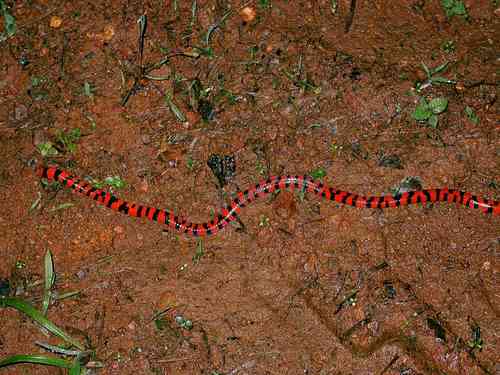
Coral Cylinder Snake
Anilius scytale
Coral Cylinder Snake (Anilius scytale) is a non-venomous snake of the family Aniliidae, found in Bolivia, Brazil, Colombia, Ecuador, French Guiana and 4 more.
Key facts
- Type
- Other
- Family
- Aniliidae
- Continent
- South America
- Constrictor
- Yes
- Snake eater
- No
- Popular
- No (Uncommon)
- Exotic
- Yes (not native to North America)
- Invasive
- No
- Common or rare
- Common (recorded in 127 places on iNaturalist)
- Photos
- Yes
- Extinct
- No
- Habitats
- Rainforests, Forests & woodlands, Savannas & grasslands, Shrublands & heath, Mountains & rocks, Underground & forest floor (estimated, as in the app)
- Venom
- Not venomous to people – it can still bite
- Adult length
- Not known (for this species; adults of its genus are about 70 cm)
- Diet
- Not known
- Reproduction
- Not known
- Size
- Medium-sized (a typical adult of its genus is about 70 cm)
- Distribution
- 8 countries and 1 territory · South America
“Mark seen” and “Want to see” open this snake in the SnakeList app, where your lists are kept on your device – tap the highlighted button on its card. “View on map” opens the app’s map on it.
Distribution
Map
Shaded countries are those where it is recorded – it does not live everywhere inside them.
States, provinces and islands where it is recorded
More detail than the countries, but still approximate. The number after each place is how many snake species SnakeList records there in all, not how many records there are of this snake.
- Bolivia: Beni (47 species in all)
- Brazil: Amazonas (85 species in all), Ceará (58 species in all), Goiás (81 species in all), Mato Grosso (100 species in all), Pará (121 species in all), Roraima (69 species in all)
- Colombia: Amazonas (51 species in all), Arauca (14 species in all), Caquetá (35 species in all), Putumayo (30 species in all)
- Ecuador: Orellana (44 species in all), Pastaza (48 species in all), Tungurahua (54 species in all)
- Peru: Loreto (59 species in all), Madre de Dios (56 species in all)
- Suriname: Sipaliwini (25 species in all)
Cities in its range
Big cities inside the states and provinces where it is recorded - not individual sightings.
- Ananindeua Brazil
- Anápolis Brazil
- Aparecida de Goiânia Brazil
- Belém Brazil
- Boa Vista Brazil
- Caucaia Brazil
- Cuiabá Brazil
- Fortaleza Brazil
- Goiânia Brazil
- Juazeiro do Norte Brazil
- Manaus Brazil
- Rio Verde Brazil
- Várzea Grande Brazil
Countries and territories where it is recorded (8 countries and 1 territory)
Behaviour and ecology
Habitat types in its range rough estimate
Habitat types found in the countries, states and provinces where it is recorded, narrowed by what kind of snake it is. They have not been checked for this species, so some may not apply.
- Rainforests
- Forests & woodlands
- Savannas & grasslands
- Shrublands & heath
- Mountains & rocks
- Underground & forest floor
- Wetlands & swamps
The 33 habitat types in the estimate
- Tropical Rainforest
- Tropical Moist Forest
- Tropical Lowland Forest
- Tropical Montane Forest
- Montane Rainforest
- Cloud Forest
- Tropical Dry Forest
- Tropical Seasonal Forest
- Evergreen Forest
- Open Woodland
- Scrub Forest
- Thorn Forest
- Mountain Forest
- Savanna
- Tropical Savanna
- Wet Savanna
- Grassland
- Tropical Grassland
- Shrubland
- Scrubland
- Mountain Slopes
- Highlands
- Underground Burrows
- Loose Soil
- Amazon Rainforest
- Amazon Lowland Rainforest
- Amazon Terra Firme Forest
- Guiana Shield Rainforest
- Andean Cloud Forest
- Cerrado Savanna
- Pantanal Wetlands
- Caatinga Dry Forest
- Llanos Grassland
Taxonomy
Who described it
Author details not available.
Where the name comes from
scytale: ‘staff, a kind of snake’
Coral Cylinder Snake: ‘Cylinder Snake’ – its body is round like a cylinder.
Worked out from the Latin and Greek roots and the words in the name; parts SnakeList can’t explain are left out.
SnakeList doesn’t list its older scientific names. The Reptile Database keeps a list of its older scientific names, with who used them and when.
Sources
SnakeList has no reviewed species account for this snake yet. The facts on this page come from SnakeList’s own checklist data (names, family, venom, and the countries, states and provinces where it is recorded).
Photo: © Olivier Fortune - Isabelle Delafosse, used under CC BY-NC; cropped and resized by SnakeList. All photo credits.
Look it up
The Reptile DatabaseiNaturalistGBIF
How this page is made
- Countries, states and provinces, venom and family come from SnakeList’s checklist; the map shades whole countries and regions, not exact range.
- Who described it: SnakeList has no checked record yet, so a name from Wikidata is shown only if it passes basic checks.
Page generated 20 November 2026
Stay safe: a photo or a web page can never tell you for certain that a snake is harmless. Keep your distance, never handle a wild snake, and get medical help straight away after any bite.