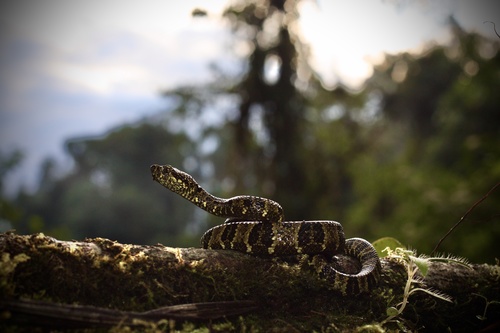
Speckled Forest Pit Viper
Bothrops taeniatus
- Venom
- Venomous
- To people
- Harmful
- Constrictor
- Non-constrictor
- Type
- Pit Viper
- Family
- Viperidae
- Genus
- Bothrops
- Continents
- South America
- Countries
- 9
- How common
- Recorded in 57 places on iNaturalist
About
Speckled Forest Pit Viper (Bothrops taeniatus) is a venomous pit viper of the family Viperidae, found in Bolivia, Brazil, Colombia, Ecuador, French Guiana and 4 more. It lives in habitats such as tropical rainforest, tropical moist forest, tropical lowland forest, tropical montane forest and 29 more. Recorded in 57 places on iNaturalist.
Where it lives
States, provinces and islands
- Bolivia: Pando 14 species
- Brazil: Acre 38 species, Amazonas 85 species, Maranhão 38 species, Mato Grosso 100 species, Pará 121 species, Rondônia 60 species, Roraima 69 species, Tocantins 25 species
- Ecuador: Morona-Santiago 48 species, Orellana 44 species, Pastaza 48 species, Tungurahua 54 species, Zamora Chinchipe 31 species
- Peru: Cusco Departament 22 species, San Martín 35 species
- Venezuela: Bolívar 11 species
Cities in its range
Big cities inside the states and provinces where it is recorded - not individual sightings.
- Ananindeua Brazil
- Belém Brazil
- Boa Vista Brazil
- Cuiabá Brazil
- Imperatriz Brazil
- Manaus Brazil
- Porto Velho Brazil
- Rio Branco Brazil
- São Luís Brazil
- Várzea Grande Brazil
Habitats
Estimated from where this snake is recorded and what kind of snake it is - not a confirmed habitat survey.
- Tropical Rainforest
- Tropical Moist Forest
- Tropical Lowland Forest
- Tropical Montane Forest
- Montane Rainforest
- Cloud Forest
- Tropical Seasonal Forest
- Evergreen Forest
- Gallery Forest
- Open Woodland
- Mountain Forest
- Secondary Forest
- Regenerating Forest
- Forest Edges
- Forest Clearings
- Savanna
- Tropical Savanna
- Wet Savanna
- Grassland
- Tropical Grassland
- Mountain Slopes
- Highlands
- Valleys
- Waterholes
- Roadsides
- Amazon Rainforest
- Amazon Lowland Rainforest
- Amazon Terra Firme Forest
- Guiana Shield Rainforest
- Andean Cloud Forest
- Andean Yungas
- Cerrado Savanna
- Pantanal Wetlands
Related snakes
- Bothrops sonene
- Brazil's Lancehead (oligobalius) Bothrops oligobalius
- Jabre’s Lancehead Bothrops jabrensis
- Moela’s lancehead Bothrops germanoi
- Marajó Lancehead Bothrops marajoensis
- Caatinga Lancehead Bothrops erythromelas
- Golden Lancehead Bothrops insularis
- Desert Lancehead Bothrops pictus
- Bolivian Lancehead Bothrops sanctaecrucis
- Cotiara Bothrops cotiara
- Fonseca's Lancehead Bothrops fonsecai
- Sao Paulo Lancehead Bothrops itapetiningae
- Piraja's Lancehead Bothrops pirajai
- Venezuela Lancehead Bothrops venezuelensis
- Urutu Bothrops alternatus
- Fer-de-Lance Bothrops atrox
- Jararaca Bothrops jararaca
- Yararanata Bothrops ammodytoides
- Fer-de-lance Bothrops asper
- Jararacussu Bothrops jararacussu
- Martinique Lancehead Bothrops lanceolatus
- Murici Lancehead Bothrops muriciensis
- Saint Lucia Viper Bothrops caribbaeus
- Jonathan's Lancehead Bothrops jonathani
- Whitetail Lancehead Bothrops leucurus
- Brazilian Lancehead Bothrops moojeni
- Barnett's Lancehead Bothrops barnetti
- Alcatrazes Lancehead Bothrops alcatraz
- Jararaca Pintada Bothrops neuwiedi
- Painted Lancehead Bothrops diporus
- Inca Forest Pit Viper (oligolepis) Bothrops oligolepis
- Osborne's Lancehead Bothrops osbornei
- Chocoan Forest Pit Viper Bothrops punctatus
- Lutz's Cerrado Lancehead Bothrops lutzi
- Green Jararaca Bothrops bilineatus
- Cacica Bothrops ayerbei
- Brazil's Lancehead Bothrops brazili
- Vitória's Lancehead Bothrops otavioi
- Venezuela Forest Pit Viper Bothrops medusa
- Marbled Lancehead Bothrops marmoratus
Stay safe: a photo or a web page can never tell you for certain that a snake is harmless. Keep your distance, never handle a wild snake, and get medical help straight away after any bite.