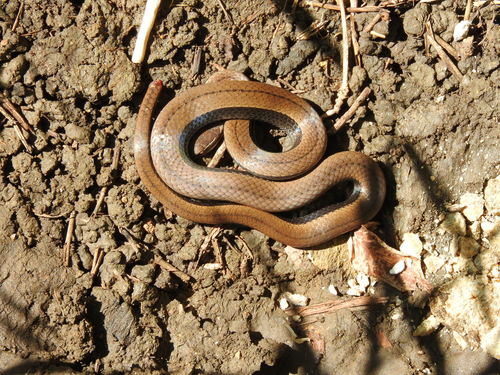
Yellowbelly Snake
Coniophanes fissidens
- Venom
- Not venomous
- To people
- Harmless
- Constrictor
- Not documented
- Type
- Colubrid
- Family
- Colubridae
- Genus
- Coniophanes
- Continents
- North America, South America
- Countries
- 11
- How common
- Common
About
Yellowbelly Snake (Coniophanes fissidens) is a non-venomous colubrid of the family Colubridae, found in Belize, Colombia, Costa Rica, Ecuador, El Salvador and 6 more. It lives in habitats such as tropical rainforest, tropical moist forest, tropical lowland forest, tropical montane forest and 29 more. Common: recorded in 171 places on iNaturalist.
Where it lives
States, provinces and islands
- Colombia: Antioquia 72 species, Bolívar 22 species, Chocó 56 species, Santander 46 species
- Costa Rica: Alajuela 80 species, Guanacaste 72 species, Heredia 58 species, Limón 62 species, Puntarenas 81 species, San José 63 species
- Ecuador: Esmeraldas 38 species, Pichincha 41 species, Santo Domingo de los Tsáchilas 19 species
- El Salvador: Ahuachapán 5 species, San Salvador 12 species
- Guatemala: Suchitepéquez 8 species
- Honduras: Atlántida 35 species, Colón 26 species, Francisco Morazán 31 species, Santa Bárbara 34 species, Yoro 18 species
- Mexico: Chiapas 103 species, Guerrero 94 species, Hidalgo 77 species, Michoacán 63 species, Oaxaca 156 species, Puebla 95 species, Querétaro 55 species, San Luis Potosí 77 species, Tamaulipas 69 species, Veracruz 122 species
- Panama: Chiriquí 44 species, Colón 25 species, Panamá 61 species
Cities in its range
Big cities inside the states and provinces where it is recorded - not individual sightings.
- Acapulco de Juárez Mexico
- Bello Colombia
- Bucaramanga Colombia
- Cartagena Colombia
- Ciudad Victoria Mexico
- Coatzacoalcos Mexico
- Floridablanca Colombia
- Heroica Matamoros Mexico
- Itagüí Colombia
- Medellín Colombia
- Morelia Mexico
- Nuevo Laredo Mexico
- Oaxaca Mexico
- Pachuca de Soto Mexico
- Puebla Mexico
- Reynosa Mexico
- San Luis Potosí Mexico
- Santiago de Querétaro Mexico
- Soledad de Graciano Sánchez Mexico
- Tampico Mexico
- Tapachula Mexico
- Tehuacán Mexico
- Tuxtla Mexico
- Uruapan Mexico
- Veracruz Mexico
- Xalapa de Enríquez Mexico
Habitats
Estimated from where this snake is recorded and what kind of snake it is - not a confirmed habitat survey.
- Tropical Rainforest
- Tropical Moist Forest
- Tropical Lowland Forest
- Tropical Montane Forest
- Montane Rainforest
- Cloud Forest
- Tropical Dry Forest
- Subtropical Dry Forest
- Evergreen Forest
- Pine Forest
- Scrub Forest
- Thorn Forest
- Montane Woodland
- Mountain Forest
- Scrubland
- Desert
- Hot Desert
- Semi-Desert
- Desert Scrub
- Mountain Slopes
- Highlands
- Plateaus
- Leaf Litter
- Fallen Logs
- Chocó Rainforest
- Andean Cloud Forest
- Chihuahuan Desert
- Mesoamerican Rainforest
- Central American Cloud Forest
- Central American Dry Forest
- Yucatán Tropical Forest
- Costa Rican Rainforest
- Panamanian Rainforest
Related snakes
- Black-striped Snake (taeniata) Coniophanes taeniata
- Joan's Snake Coniophanes joanae
- Chiapan Stripeless Snake Coniophanes alvarezi
- Peters' Running Snake Coniophanes dromiciformis
- Stripeless Snake Coniophanes lateritius
- Black Banded Snake Coniophanes melanocephalus
- Cope's Black-striped Snake Coniophanes piceivittis
- San Andres Snake Coniophanes andresensis
- Lonely Spotbelly-Snake Coniophanes longinquus
- Five-striped Snake Coniophanes quinquevittatus
- Two-spotted Snake Coniophanes bipunctatus
- Peninsula Stripeless Snake Coniophanes meridanus
- Faded Black-striped Snake Coniophanes schmidti
- Guerrero Black-striped Snake Coniophanes taylori
- Michoacan Black-striped Snake Coniophanes michoacanensis
- Black-striped Snake (imperialis) Coniophanes imperialis
Stay safe: a photo or a web page can never tell you for certain that a snake is harmless. Keep your distance, never handle a wild snake, and get medical help straight away after any bite.